Portrait of a Garden
As an artist and collector of images, Instagram can be a huge source of ideas and inspiration. I’ve long been a fan of Great Dixter House and Gardens and have painted it many many times. About 4 years ago, I followed a hashtag and found myself looking at the posts of Rother Ramblings aka top gardener Ed Flint. I loved his musings on all things botanical but also his joy in life itself. His writings are poetic and rambling, hence the name. This intrigued me when aligned with the obligatory photos of the little piece of heaven that he’s created in Sussex.
The garden did remind me of Dixter but only in so much that it’s based around some of its principles of abundant planting. In Ed’s garden he’s worked very carefully with the owner (P) to push the limits of the ideas of Dixter. Yes, those gardeners who are familiar with Great Dixter garden might find that hard to believe, but let me discuss the D bed.
So called because……
As you enter the garden, you see raised beds, a couple of beautiful liquid ambers and some ebullient planters but then you walk through an archway of bricks and BOOM.
Ed said, on my first visit, that my reaction was correct. I laughed. In fact, I’ve rarely laughed with joy like that. I was taken aback. The house has been extended with a glass dining room which slides into the space perfectly. The bed itself measures ….. and yet within this space is the most beautiful piece of theatre. The colours, textures and movement of the plants jostle for attention, but they’re all completely integral to the effect. I was stunned by the work as it must have taken years to achieve this apparent ‘ease’ of planting, but the trialing of certain plants and the adjustments that must have been made over the years belies the simple joy that it beholds.
It takes a very long time to make something so difficult look so easy. As I well know.
It didn’t take more than a nano second to realise that I’d found my muse. I’m a sucker for colour and tone but this was a ready-made painting. All that I needed to do was get to work.
I took so many photos to look at in the studio.
This is a complex garden, made up of several different ‘rooms’. It’s not a one trick pony. It’s a garden that gives and gives. There’s the gold garden, a confined space full of big leaved plants in mainly green and yellows.
There’s the hydrangea walk with lilies where you feel like you’ve stumbled upon a patch of the Himalayas.
The long border planted under 2 magnificent magnolias where the planting is soft and floating. Full of flowering perennials and old roses.
Once I arrived back in the studio, I printed out some images to look at.
This is my working method.
I like to go a bit old school where I can collage images together on pieces of paper and live with them for a few weeks.
I then make some compositional sketches to consider the scale and format of the potential works.
Once these foundation pieces are in my mind, the initial marks can be made on a canvas or panel.
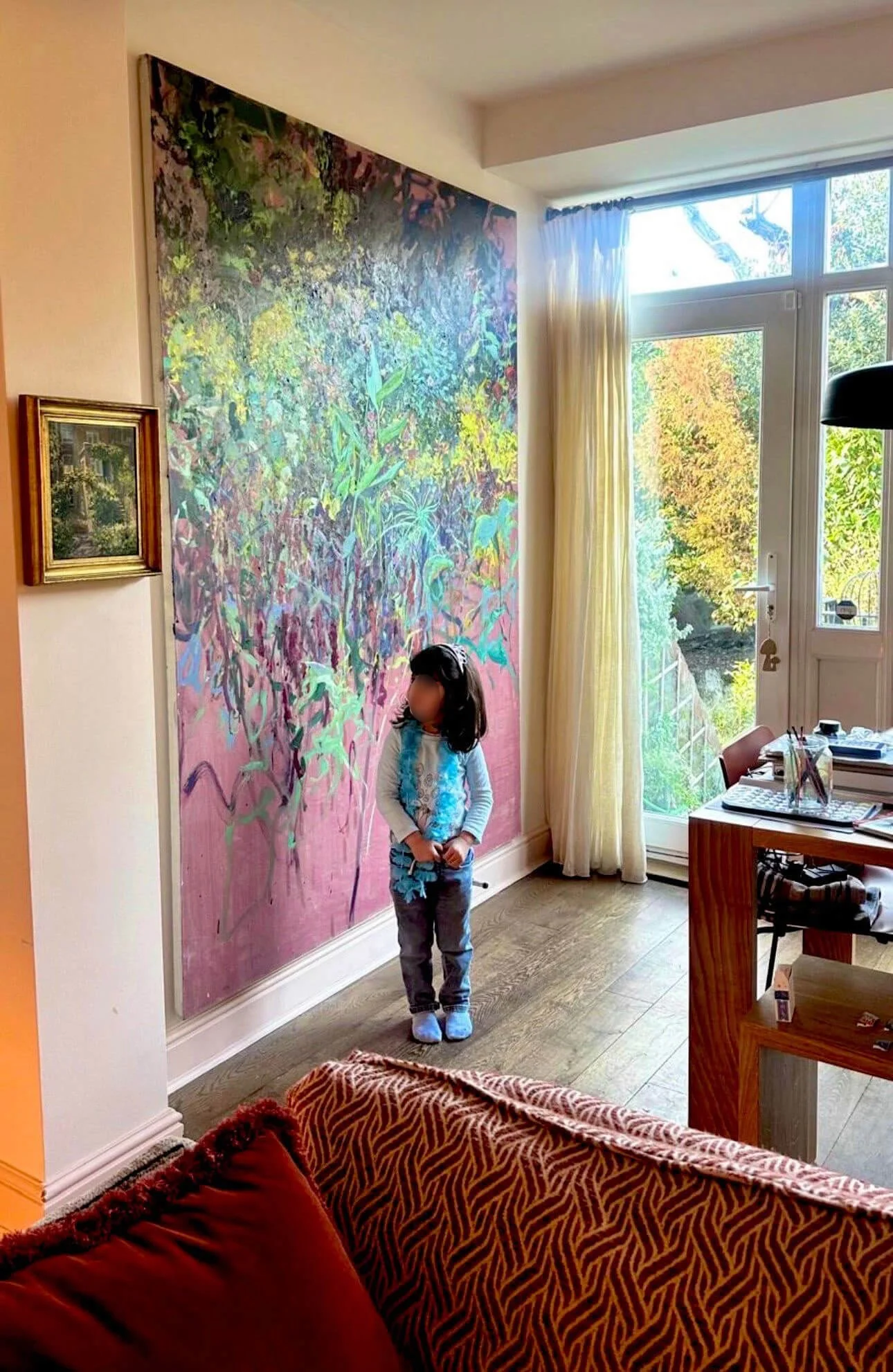
Being from a traditionally trained painting background, colour theory is involved from the outset. If the main body of the painting is to be green, then the ground/under painting must be pink. This sounds comparatively simple and yet, it’s fraught with complications. I’ve taken this a step further, as I find that the ‘dazzle’ on the retina of the viewer can be further enhanced by the adjustment of the tone of the ground. The shade of the colour is possibly more important to me than the colour itself. So if the foliage is predominantly lime green then I’d be looking for a darker, bluer red, like alizarin crimson or even magenta. As I use oil paint, the ground has to be allowed to fully cure (dry) as the subsequent layers of paint can sink if not.
I tend to make several pieces at the same time to develop ideas and push them further.
In the development of this series of work, I made 5 smaller pieces initially. They ranged from 20cm x 80cm to 30cm x 120cm. Four were on oil primed canvas and one was on an aluminium panel. I also like to vary the surfaces that I use to vary the feel of a piece.
The initial studies have led on to larger pieces. The largest being 100cm x 250cm and 170cm x 220cm.
One of these larger works found a particularly special home. The garden owner loved the large painting so much that she purchased it, and it now hangs in her house — positioned so that the real garden can be seen through the windows beyond. The painting and the living landscape sit in quiet dialogue with one another, echoing colour, movement and memory. It feels less like a depiction and more like an extension of the garden itself, carried indoors.
Commissions
If you’re reading this and the details appeal — as in you have a beautiful garden that you’ve created through blood, sweat and tears and you’d like a permanent and beautiful memory of it — then don’t hesitate to contact me or come and visit my new studio near Lewes.